International Women’s Day
Authors: AFC Ambassadors, Tassia, Lily and Nasreen
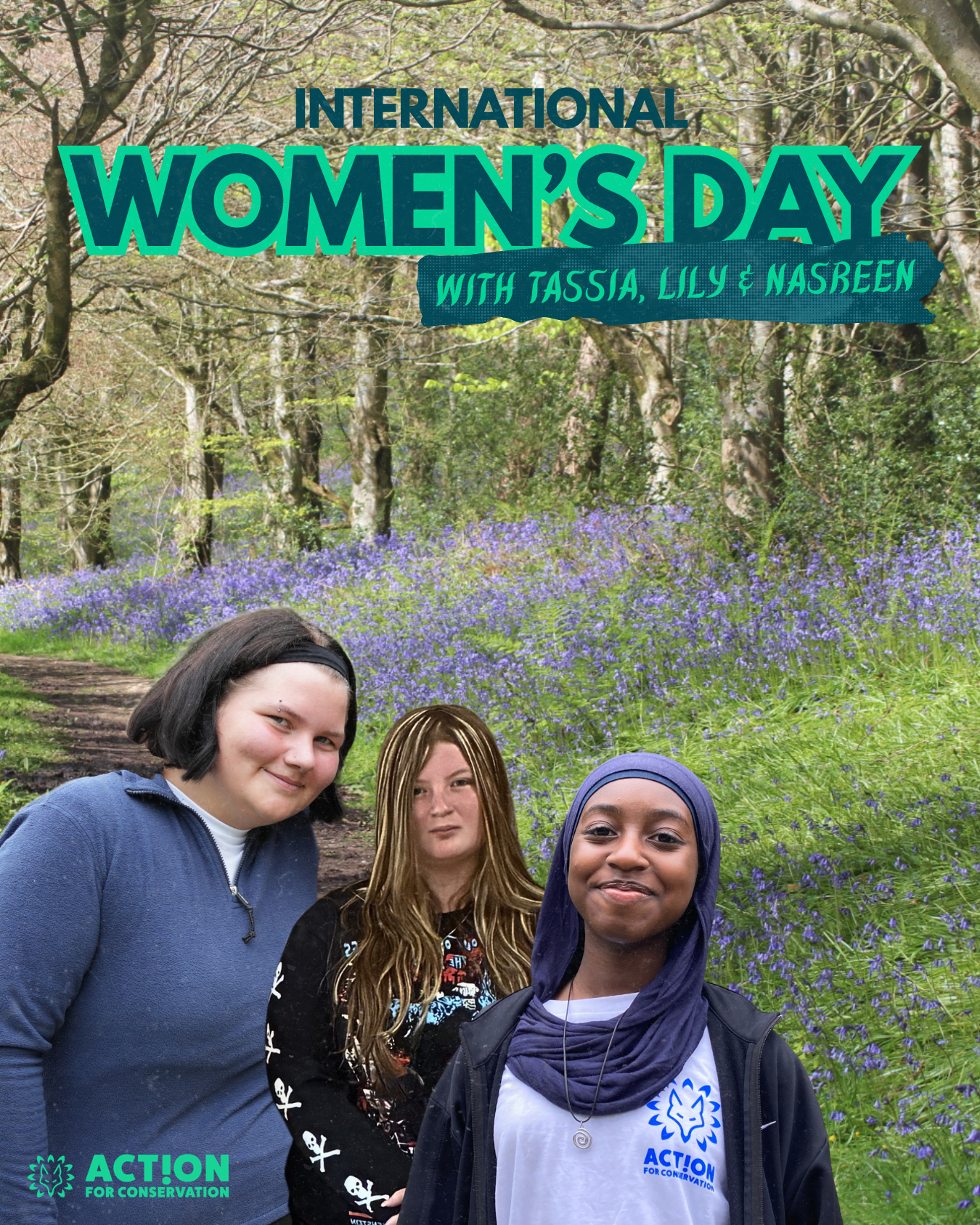
This International Women's Day 2026, Action for Conservation (AFC) interviewed three of our current Ambassadors, meet Tassia, Lily and Nasreen from across England. We asked them about what nature means to them, and what it means to be a young woman in the environmental space.
Here is what they have to say about the ‘power of girlhood’ in nature.
Why is nature important to you?
Tassia: Nature to me is very grounding. Given all the hectic stuff with GCSEs and college, to go outside and relax, it lets you forget about all of that a little bit. It's one of those things you could do with other people, or it could just be you going wherever you want to go. It’s open and makes you feel like you could do anything.
Being with other people, I get to share my knowledge about anything to do with nature. Especially since I've been on Camp, I've learned a lot. Even if you're not talking and just being with someone in the moment, it's like you've got someone there.
When I'm by myself, it's like, I need a break from everything. In nature, there's nothing there, but there's a lot there. It's very calming and grounding. You don't have anyone telling you what to do, there's no one being judgmental. You just do what you want to, and the more you are able to focus on the things around you, and the more you notice, because there's a lot there, the more you look. That is very relaxing.
“It's almost like you're doing work that you enjoy with calming music behind you. But then the music is the birds, maybe some of the bushes, like rustling with the wind. It's almost like it's not real. You're just floating on clouds.”
Nasreen: Being in nature is one of the most important things to me because it gives me a sense of like calmness and to just be with myself. It makes you feel grateful for being alive and knowing that we didn't create this, it's like we're just living in God's creations.
Lily: I feel connected to nature because whenever I’m in it, it’s like all the weight has been lifted off me. I forget about everything going on in my life and can focus on the littlest things, like the air. It’s a really peaceful feeling and brings me a lot of joy. I think, especially in this generation, it’s super important for kids to be getting out and involved in nature to really get a feel of the real world and what it holds, since most kids spend a lot of time on the internet and they miss out on the outside world. So I think it’s super important to push them towards seeing nature.
How has taking part in hands-on conservation activities and spending time in nature with other young people impacted you?
Nasreen: Doing hands-on activities makes you feel connected on another level, just being yourself with other people, admiring where you are and not taking it for granted. When we went foraging, knowing that from a lot of things that are out in the wild, you could create such beautiful dishes, and it ends up tasting amazing. You look at it, you don't think much of it, but when you realise it has so much benefit and it's really good for your health, it just makes you just say, Wow.
“Before AFC, I disregarded being in nature, and would always stay inside. After AFC, I’ve reflected on how much we’re impacting nature, and how much it affects us, and just how it really is part of our lives.”
It’s really important for young people to spend time in nature, especially if things are going forward. More people are on devices and online, and people don't really spend that much time outside. Slowly they’ll just forget about nature, and it will become extinct. Spending time in nature would help that as it would make them be more appreciative of where they're living, how it could really affect them and take a toll on how they act in their lives.
Tassia: After [AFC’s Summer] Camp, I'm more open. I learned a lot. So it's like I'm able to engage in and gain new knowledge. Doing the hands-on conservation, it made me realise how easy it is to do it, and how quick it can be. When out and about, you might have ideas to do it, but you don't know how to go about it. So at Camp for example, being able to go to the Seven Sisters and doing hands-on conservation, it's really quick and easy to do, and it was actually quite therapeutic.
You've got the scientific side where you have studies showing how nature helps people's mental health. It can be a way for you to turn off, especially as being young can be really stressful, with the pressure of A-levels, GCSEs, friends and everything, it's just a way you could just turn off and forget everything that's happened and just focus on yourself. It's almost like you're pausing everyone else and focusing on yourself, seeing what you need to do as a person to grow and relax
Why do you think it is important for women and girls to be in leadership positions?
Lily: I think it’s important that women and girls have leadership roles in nature as well as men, because both genders can have different takes on it and different ideas to move forward with, so I think it would be nice to open it up for anyone’s opinion, including women.
Tassia: I think it's important for everyone to have the opportunity. But given the past, it was very male-centric. I feel like now, women are getting more recognition for what we're able to do. I think it's very important they get given these opportunities as people have different opinions. I think, as a woman, how I perceive things will be different to a man. Being able to be in a role of power, I'm able to share my opinions and have a cause to do something to impact other people.
I've always been opinionated. Some of the people at Camp, for example, weren't going to speak up, but then everyone gave them the option to speak up, share their opinions.
“I think having women in leadership invites those people that may not feel like the courage to be able to speak up themselves.”
Nasreen: It is really important because throughout history, women have not been treated right and thinking they're less than men. There's always been a patriarchal society, so now it's really good for women to take action and show that it’s not just men, but that women can also take action too!
How has your girlhood inspired you and who inspires you?
Lily: When I was at Camp, I was heavily inspired by the AFC’s Programme Manager, Holly, and how she acts around nature. It’s what really made me want to become more active in it and take more of a stand. I think with women, being in the relaxing, quiet environment of nature is all we need, and we can appreciate it quite a lot.
Tassia: I think the whole thing with girlhood, it's like each person's different, so it's like we have this whole connection, where you talk to other people and you all help each other out. I knew Raquel [AFC South East Programme Coordinator] from other things before AFC, and then she's given me the connection with the other workers [at AFC], the other people that were on Camp, which has helped me look into other things to do with nature and conservation. If I if I wanted to do something else, there'd be other connections for me to go into that. That's why I really like the power of girlhood. The AFC people and even the volunteers like you're all so knowledgeable in what you do, and even if one of you was unsure, you were like, this person will know, which was quite good. And then I also was part of the Girls Network a few years back, so that's also given me my mentor. I did it with Dawn. She was really lovely. And she did a similar thing where it's like, if she didn't know, she put it on someone she does know. Coming out of girls network, there's a whole network of people now that I still talk to.”
Nasreen: Girlhood has inspired me being connected and in unity and relatable with other people, knowing that you've shared the same experiences, and that we're all connected and we feel the same emotions and there's no reason for hatred. So at the end of the day, we're all just together.
“A lot of my friends have influenced me being part of nature and being part of a cause to conserve nature. To do that together is bonding, it shows unity.”
How we could bring peace while being in nature. Greta Thunberg, especially since she came from a background where people put her down and said that her ideas weren't accepted. She didn't care what they said, and just continued doing what she does. Catherine Johnson and the women that helped NASA are inspiration to me, even if it is not related to nature. She's also still really empowering women. I really see a lot of empowerment that we can get from the work that she did.
What’s your final message this International Women’s Day?
Nasreen:I wanted to be involved and help with what's going on for International Women's Day knowing that women can do anything that men could do. It's amazing to be a woman, it feels really amazing.
Tassia: We're in a society where being seen as a feminist can be seen as bad, when the whole point of feminism is to want to be equal. For me (because I am very into the politics) things that have been said recently, for example, Reform UK candidate, Matt Goodwin, saying there should be a tax on women who don’t have children, where how they’ve worded it is directed at women, and so it’s feels like we are in a society, that is kind of going backwards.
“You always hear of girls in STEM, for example, and that once wasn’t allowed, but now it should be, girls doing anything they want to do.”
Why are we putting like emphasis on just STEM? It's like they got the very stereotypical men's job from the past and tried to have girls go into it, but then you got the very stereotypical men's jobs now like woodwork or carpentry, and we are just going to ignore and let that still be a male dominated industry?
Also, I think there's a lot of jobs that are stereotypically women's jobs that men feel like they can't do. So I think it's also important as women to say we want to be able to do this, but also share it and say men can do this too, have those options as well. Just do what you want to do. If you work hard and ignore everyone else, talk to people and value people's opinions that are going to help you get there, then you'll get what you want.
Lastly, do you have any advice for a young girl who might want to get involved with AFC?
Tassia: You meet new people, you have new connections, and it's really eye opening. Although it's very nature-based and conservation-based, it really opens your eyes to other issues. Even if you're not the most interested and you don't want to go into a career, it's very eye opening. You create a network of people. I still talk to quite them, people that I met there. It's just quite nice in the sense that you've learned something new. I've always seen knowledge as power, so it's like you're broadening your knowledge.
Nasreen: I would tell her to really take the opportunity. She should really do it because it was one unforgettable experience. It really taught me a lot of things I didn't know, and it just makes me be more appreciative of nature and being human in this world.
“It is awesome knowing that there's always a safe space in for you in nature, and that if you help, it won’t go away.“
That feeling of belonging in nature, just take the opportunity of helping nature so it doesn't go away, and other generations could enjoy it and be appreciative of where we live.
Lily: If a young girl were to come to AFC, I would advise her not to feel anxious or on edge, just keep calm and let herself enjoy her surroundings in nature instead of worrying about anything else.
Thank you for reading this special International Women’s Day edition of the AFC Blog!